OUR SOLUTION
STRENGTHENING NATURAL LANDSCAPES
The Open Spaces Resiliency Project (OSRP) works to strengthen North Carolina’s natural landscapes by improving resilience to drought and wildfires, while expanding habitat for endangered species across the state’s open spaces.
Our approach combines stream restoration and stormwater management in a way that works with nature—not against it. Instead of quickly moving water off the land, we focus on five key principles: slow it down, spread it out, store it across the landscape, and share its benefits throughout the ecosystem.
By restoring these natural water processes, OSRP helps reduce erosion, recharge groundwater, support healthier soils, and create more stable, connected habitats. The result is a more resilient landscape—one that can better withstand extreme weather, support wildlife, and provide long-term benefits for communities, landowners, and the environment.

WORKING WITH NATURE
LOW-TECH PROCESS-BASED RESTORATION (LTPBR)
This approach to restoring degraded riverscapes uses simple, low-cost, and largely hand-built methods that work with natural systems rather than against them. Instead of relying heavily on machinery, LTPBR focuses on mimicking and reactivating natural processes—such as water flow, sediment movement, and vegetation growth—to help rivers recover and sustain themselves over time.
The ultimate goal is to move from short-term interventions to long-term, self-sustaining ecosystems, where natural processes maintain the health of the riverscape without ongoing intensive management.
This approach is used in Utah and is supported by Utah State University’s Restoration Consortium. They offer a wide range of free resources—including a comprehensive design manual, field guides, and self-paced learning modules—as well as training opportunities for students and professionals. These courses and tools are designed to build skills in understanding riverscape health, identifying restoration strategies, and applying low-tech techniques in real-world settings.
Low-Tech Process-Based Restoration of Riverscapes
Utah State University — Joe Wheaton Lab (ETAL)
A Low-Tech Process-Based Restoration Planning & Design Manual
U.S. Fish & Wildlife Service and Utah State University (2019)
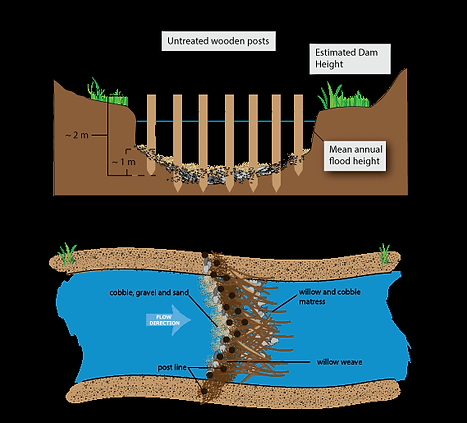
BEAVER DAM ANALOGS
A central component of the LTBPR approach is the use of Beaver Dam Analogs (BDAs)—human-made structures designed to mimic natural beaver dams. Built from natural materials like wood, vegetation, and sediment, BDAs are installed in streams to slow water movement, raise water levels, and reconnect streams to surrounding wetlands. By slowing and spreading water across the landscape, these structures help reduce erosion, trap sediment, and create more complex stream habitats. Over time, this supports vegetation growth, improves water storage, and enhances habitat for fish and wildlife.
LTPBR techniques, including BDAs and similar structures like post-assisted log structures (PALS), are intentionally low-cost and low-impact. They are typically built by hand using locally sourced materials and are designed to initiate natural recovery processes rather than impose permanent structural change.
Overall, this approach emphasizes working with nature to restore riverscapes—encouraging self-sustaining systems that are more resilient to disturbance, drought, and long-term environmental change.
Beaver Dam Analogs (NRCS Tech Note)
USDA NRCS Engineering Technical Note 420
National Riparian Service Team – NRST BDA/Low-Tech Resources
Bureau of Land Management
Our PARTNERS